Roadside Assistance in the Electric Vehicle Era: New Challenges and Solutions for 2026
The electric vehicle revolution has transformed how Europeans drive, but it has also fundamentally changed what happens when something goes wrong on the road. With the global roadside assistance market valued at $32.8 billion in 2026 and projected to reach $41.33 billion by 2031, the industry is racing to adapt to a new generation of vehicles that demand entirely different expertise, equipment, and response protocols. For drivers making the switch to electric, understanding these changes is not just interesting — it is essential for staying safe and prepared on every journey.
Whether you drive a fully electric car or manage a mixed fleet, knowing how modern breakdown services are evolving will help you make smarter decisions when you need help most.
Why EV Breakdowns Are Different from Traditional Ones
At first glance, a stranded car is a stranded car. But the reality for electric vehicles is far more nuanced. The most common reason an EV ends up needing roadside assistance is a drained or flat high-voltage battery — the electric equivalent of running out of fuel, yet considerably more complex to resolve. You cannot simply walk to the nearest station with a jerry can. A flat EV battery requires either a mobile charging unit or a flatbed truck to transport the vehicle to the nearest viable charger.
Beyond the battery, EVs present a range of unique breakdown scenarios:
- High-voltage system faults — Electrical failures in the drivetrain, inverter, or battery management system require technicians trained in high-voltage safety protocols. A conventional mechanic cannot safely diagnose or handle these components.
- Increased tyre wear and blowouts — Electric vehicles are significantly heavier than their internal combustion engine (ICE) counterparts due to battery weight. This additional mass accelerates tyre degradation, making roadside tyre incidents more frequent for EV drivers.
- Software and connectivity failures — Modern EVs rely heavily on software for everything from door locks to charging management. A software glitch can leave a driver locked out or unable to start the vehicle, requiring specialist emergency vehicle access and diagnostic tools.
- Charging infrastructure failures — A broken public charger in a remote area can turn a planned stop into an unplanned breakdown. Range anxiety is not just psychological — it leads to real stranding incidents when charging networks prove unreliable.
These differences mean that the traditional toolbox and skillset of a roadside technician are no longer sufficient. The industry is being forced to retrain, re-equip, and rethink its entire approach.
The Growing Skills Gap in Roadside Assistance
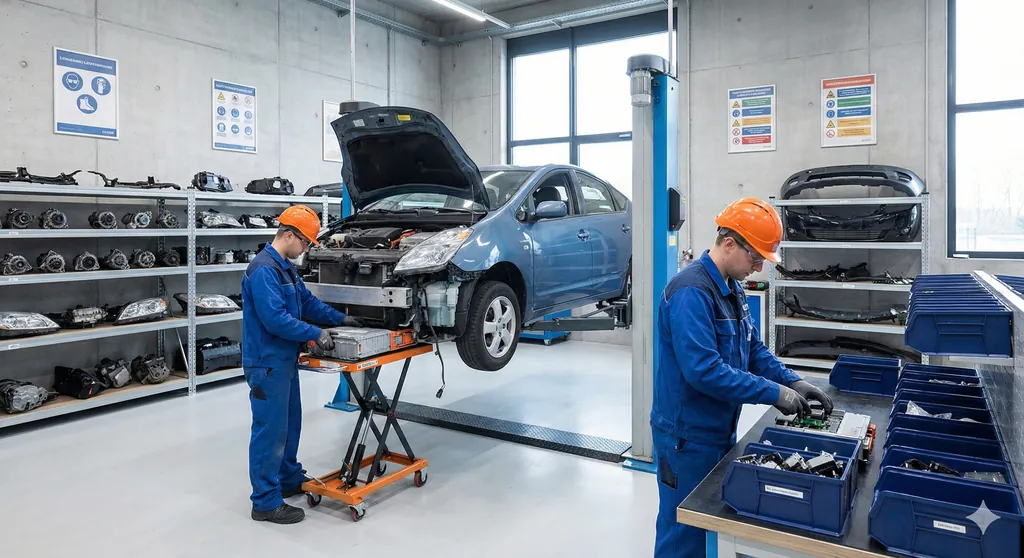
One of the most pressing challenges facing the roadside assistance sector in 2026 is a significant shortage of technicians qualified to work on electric vehicles. High-voltage battery systems operate at levels that can be lethal if mishandled, and regulatory frameworks across Europe now require specific certifications before a technician is permitted to touch an EV drivetrain.
This skills gap creates real consequences for drivers. Response times for EV-specific breakdowns can be longer in regions where qualified technicians are scarce, particularly in rural areas and smaller European countries where EV adoption has outpaced workforce training. For businesses operating electric fleets, this gap makes it critical to partner with a breakdown service provider that has invested in EV-certified teams and can guarantee competent response regardless of location.
The training requirements are substantial. Technicians need to understand battery chemistry, thermal management systems, regenerative braking diagnostics, and the safe handling procedures for damaged lithium-ion cells — which in the worst case can enter thermal runaway. This is a far cry from jumpstarting a flat 12-volt battery or changing a fan belt.
Flatbed Towing: The Only Safe Option for EVs
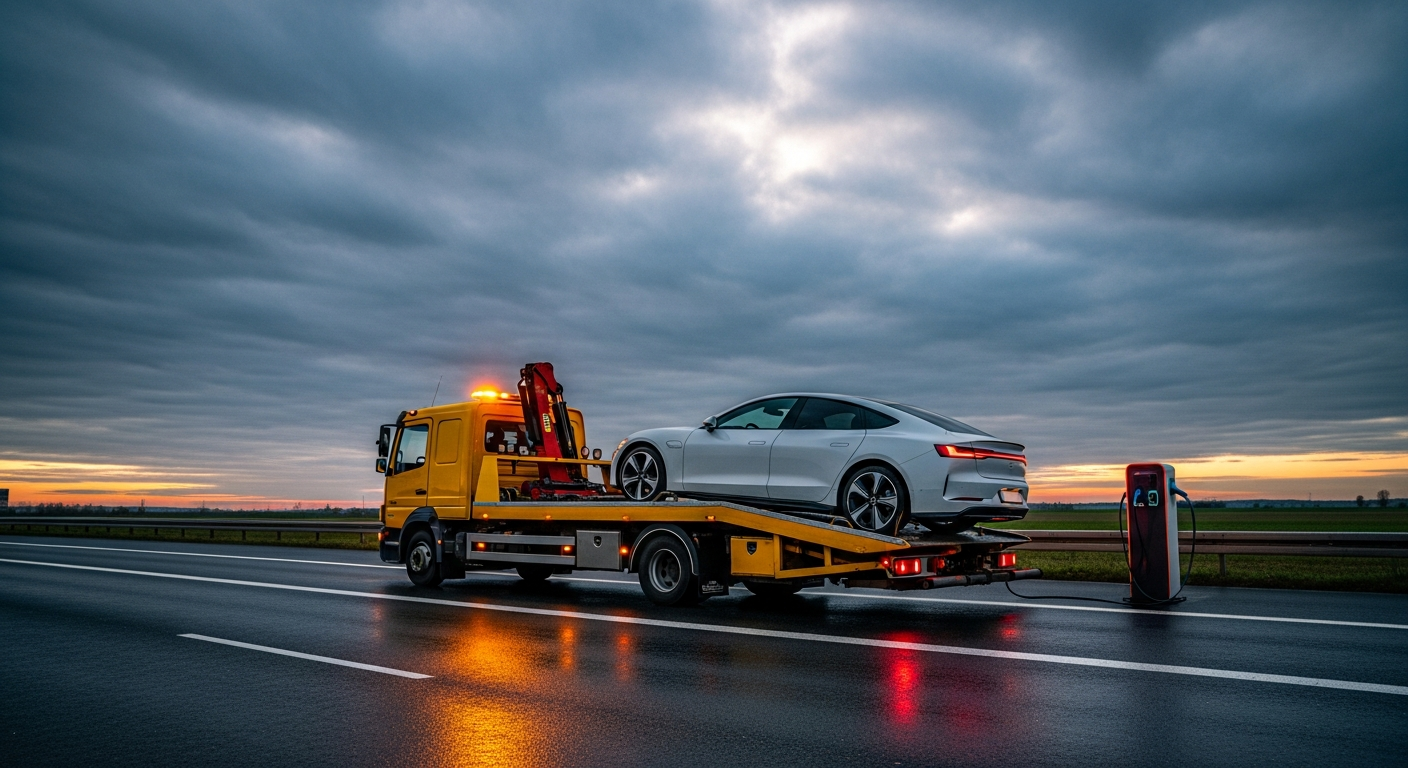
One of the most important things any EV driver should know is that their vehicle must be towed on a flatbed. Unlike ICE vehicles, which can often be towed with two wheels on the ground, electric vehicles risk serious drivetrain damage if their wheels are forced to turn while the motor is not actively engaged. The electric motor and the wheels are directly connected, and dragging an EV can generate electrical current that damages the inverter and motor windings.
This requirement has significant implications for roadside assistance operations. Flatbed trucks are more expensive to operate, slower to deploy, and less widely available than traditional tow dollies. Providers offering professional vehicle towing have had to expand their flatbed fleets substantially to keep pace with EV growth, and drivers should always confirm that flatbed service is guaranteed before signing up for any roadside assistance plan.
For those managing commercial or corporate vehicles, integrating flatbed-only towing requirements into fleet breakdown management protocols is now a baseline expectation rather than a special request.
Mobile Charging Units: The New Rescue Vehicle
Perhaps the most visible change in roadside assistance is the emergence of mobile charging units as a standard part of rescue fleets. These vehicles carry high-capacity battery packs or generator-fed charging systems capable of delivering enough energy to get a stranded EV to the nearest charging station — typically a 10 to 30 kilometre range top-up delivered in 20 to 40 minutes.
EV-related roadside services are growing at a compound annual growth rate of 10.83% through 2031, and mobile charging is driving much of that expansion. The economics are compelling: deploying a mobile charger is far cheaper and faster than dispatching a flatbed to tow a vehicle that simply ran out of energy. For the driver, it means getting back on the road in under an hour rather than waiting for a tow and then waiting again at a charging station.
Leading EV breakdown and charging assistance providers across Europe are now equipping their fleets with these units as standard, and drivers should look for this capability when evaluating their roadside assistance options.
How Connected Cars and Telematics Are Changing Response Times
The silver lining of the EV era is that electric vehicles are, by nature, highly connected. With an estimated 132 million ADAS-equipped vehicles now on European roads, the data flowing between cars and service providers is enabling a fundamentally smarter approach to breakdowns.
Connected car telematics allow for:
- Predictive maintenance alerts — Onboard systems can detect battery degradation, tyre pressure anomalies, and component wear patterns before they cause a breakdown, sending warnings to drivers and fleet managers in advance.
- Automatic breakdown detection — When a vehicle detects a critical fault or stops unexpectedly, it can automatically notify the nearest assistance provider with precise GPS coordinates, battery state-of-charge, and fault codes.
- Optimised dispatch — Knowing the exact nature of the problem before a technician is dispatched means the right vehicle with the right equipment and the right expertise arrives first time, eliminating wasted trips and reducing average response times.
- Remote diagnostics and resolution — In some cases, software-related issues can be diagnosed and even resolved remotely via over-the-air updates, avoiding the need for physical assistance entirely.
For fleet operators considering the shift to electric, the interplay between telematics and roadside assistance is a major operational advantage. Our fleet electrification guide covers how to build these capabilities into your transition plan.
Range Anxiety and Infrastructure Gaps: A Practical Reality
Despite rapid expansion of charging networks across Europe, infrastructure gaps remain a leading cause of EV roadside incidents. The problem is not just the total number of chargers — it is their reliability, distribution, and compatibility. A driver relying on a single charger in a remote stretch of motorway has no backup plan if that unit is out of service.
Practical steps to reduce your risk of a range-related breakdown include:
- Plan routes with multiple charging options — Never depend on a single charger. Use apps that show real-time charger availability and have at least one alternative within range.
- Understand your real-world range — Manufacturer estimates assume ideal conditions. Cold weather, motorway speeds, heavy loads, and use of heating or air conditioning can reduce range by 20 to 40 percent.
- Monitor battery health — Degraded batteries hold less charge than their rated capacity. Regular EV diagnostics can identify capacity loss before it leaves you stranded.
- Carry a reliable roadside assistance membership — Ensure your provider offers mobile charging as part of their standard breakdown service package, not as an expensive add-on.
For a deeper understanding of battery longevity and what happens when an EV battery reaches end of life, our EV battery recycling guide offers practical insights.
What to Look for in an EV-Ready Roadside Assistance Provider
Not all roadside assistance providers are created equal in the electric vehicle era. When evaluating your options, whether as an individual driver or a fleet manager, look for these capabilities:
- EV-certified technicians — Confirm that the provider employs technicians with recognised high-voltage vehicle training, not just standard automotive qualifications.
- Guaranteed flatbed towing — Ensure that flatbed service is the default for EVs, not subject to availability or extra charges.
- Mobile charging capability — Providers with mobile charging units in their fleet can resolve the most common EV breakdown faster and more affordably than those relying solely on towing.
- Pan-European coverage — EV charging infrastructure varies dramatically between countries. A provider with consistent coverage across borders is essential for anyone driving internationally.
- Telematics integration — The ability to receive automatic alerts from your vehicle and dispatch assistance proactively is a significant advantage.
Choosing the right partner before you need one is far better than searching in a moment of crisis. Our guide on choosing reliable roadside assistance in Europe can help you evaluate your options systematically.
The Road Ahead
The transition to electric mobility is irreversible, and the roadside assistance industry is adapting at pace. Mobile charging fleets are expanding, technician training programmes are scaling up, and connected vehicle technology is making breakdowns both less frequent and faster to resolve. But the transition is not complete, and drivers who understand the unique risks and requirements of EV ownership are better positioned to travel confidently.
At InterCar, our breakdown service is built for the realities of 2026 — with EV-trained technicians, flatbed towing as standard, mobile charging capability, and coverage across Europe. Whatever you drive, wherever you are headed, preparation is the best roadside assistance of all.